
A new look at old images
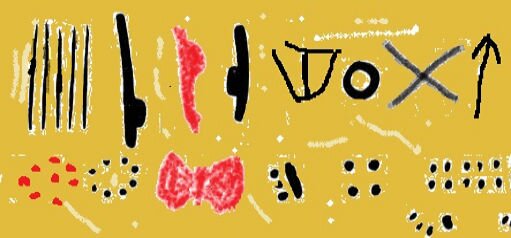
Signs
The colours
You may be surprised to find colours listed first as "signs".
But colours are powerful symbols, even today: green = go, red = stop.
Green was not used in the Ice Age because there were no traffic lights yet. Red was still popular, as were black and white.
Black is the colour of the new moon (or black moon) and accordingly stands for the beginning, the origin. White is the colour of the full moon. The colour red was taken from the sunrise, but also stands for the new sun in spring and the waxing moon.
You may have read something different in Robert Ranke-Graves or Heide Göttner-Abendroth (red is supposed to be the colour of the full moon, etc.), but this is not correct.
An aurochs from the Panel of the Horses, Chauvet cave.
The aurochs represents the new moon. The black colour also indicates the black moon or new moon, the beginning of the moon's development or the "birth" of the moon. The horns are shaped like the waxing moon.
Photo: © Patrick Aventurier; Chauvet Cave 2
Graphic symbols
Dots and lines are the simplest symbols of this kind. And they are also the most difficult to interpret.
They could be numbers. But representing the number 60 with sixty dots, which you then have to count individually, would be rather silly. That's why I think dots mean something else, namely sun signs and signs of origin.
Lines are more likely to represent numbers. They occur in smaller groups than dots.
If you have already read the page on sky observation, you will certainly remember the sun diagram, the image of the wandering sunrises and sunsets with the solstice lines.
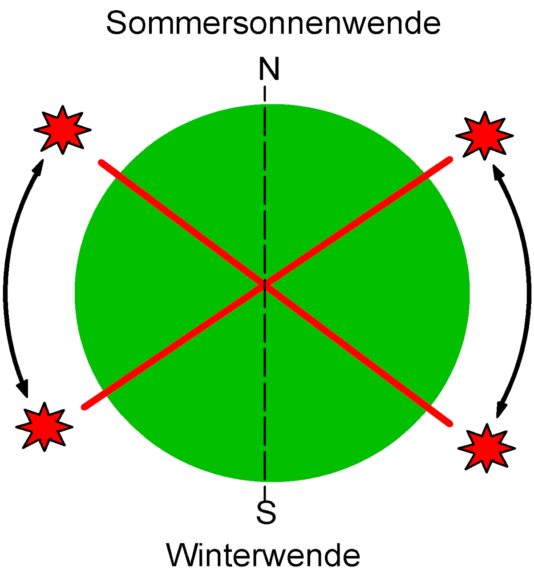
This solstice diagram X was used by Ice Age people to refer to the solstice on their paintings:
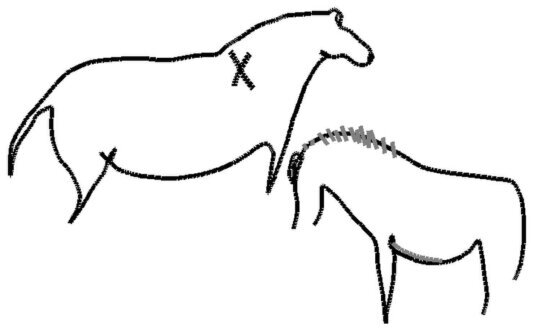
top left: drawing at the turning point in
the end of Niaux cave.
The winter solstice is depicted twice,
by the twin horses and the solstice symbol X.
(Drawing: H Ulrich after J Clottes)
Bottom left: from Le Gabillou cave.
A horse's head with an X is also sufficient
to denote the solstice.
(Drawing: J Gaussen)
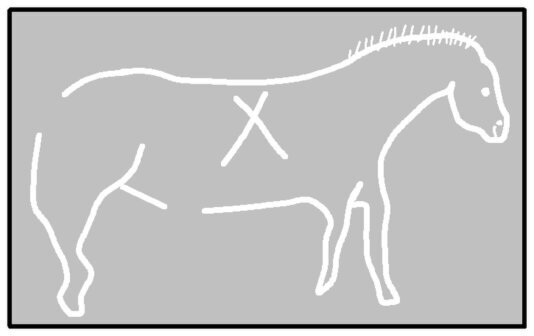
Top right: from the Les Combarelles cave.
Just one horse (No. 72) and the solstice symbol
are sufficient to write the term "solstice".
(Drawing by H Ulrich after Abbé Breuil)
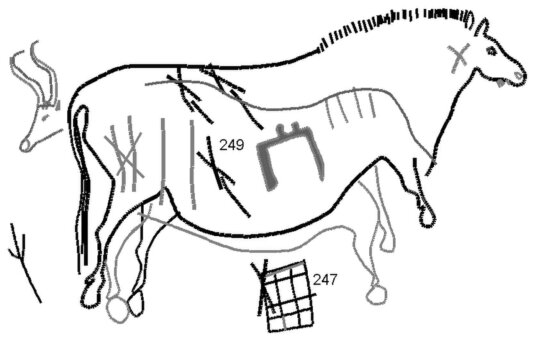
Bottom right: Lascaux, in the "apse",
a dead end.
Here, the winter solstice is emphasised by the
vertical line.
(Drawing by H Ulrich after Abbé Glory)
Since there are two solstices, summer solstice and winter solstice, two different symbols were needed to represent the two solstices individually and unambiguously. This was not difficult,
because the solstice-sign X is already a composite symbol.
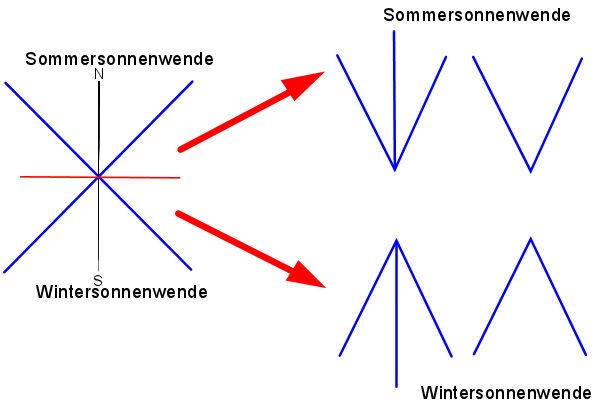
The angles with the centre line, often interpreted as arrows (which did not exist in Europe at cave painting time)
or spears, are solstice symbols. The same applies to the simple angles.
(You may have read something different by the famous symbologist Robert Langdon. However, I must tell you that this is a later invention.)